We were visiting friends on the South Coast when they said “Would you like to see the church at Old Romney?”. I’m always up for viewing a church.
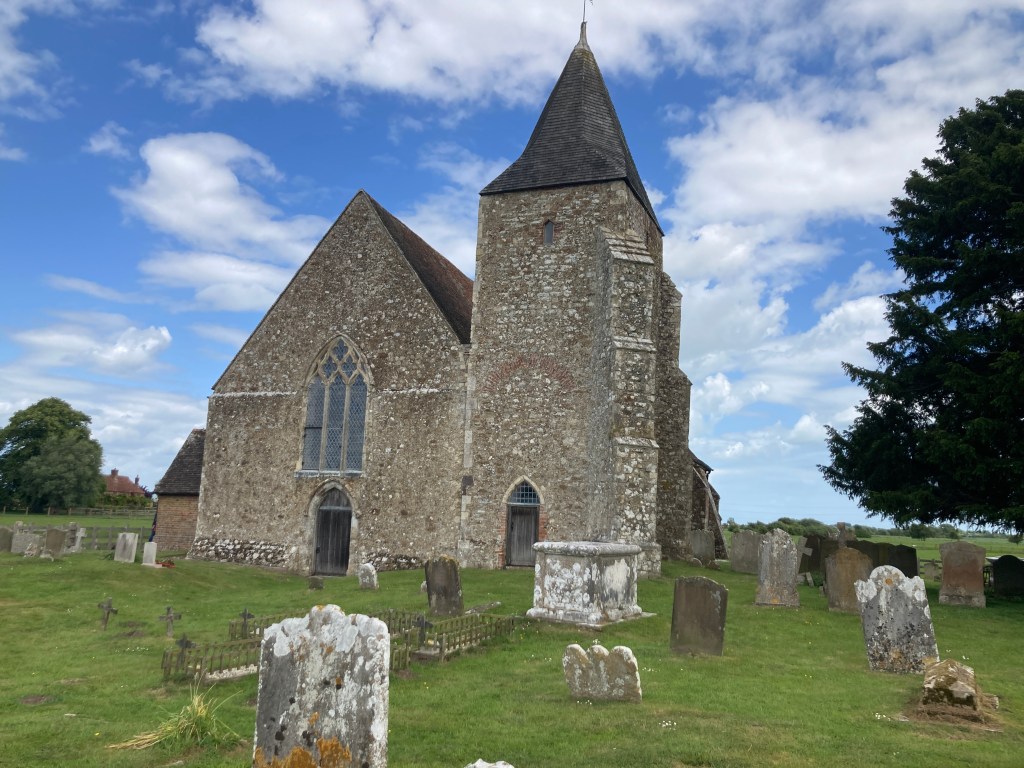
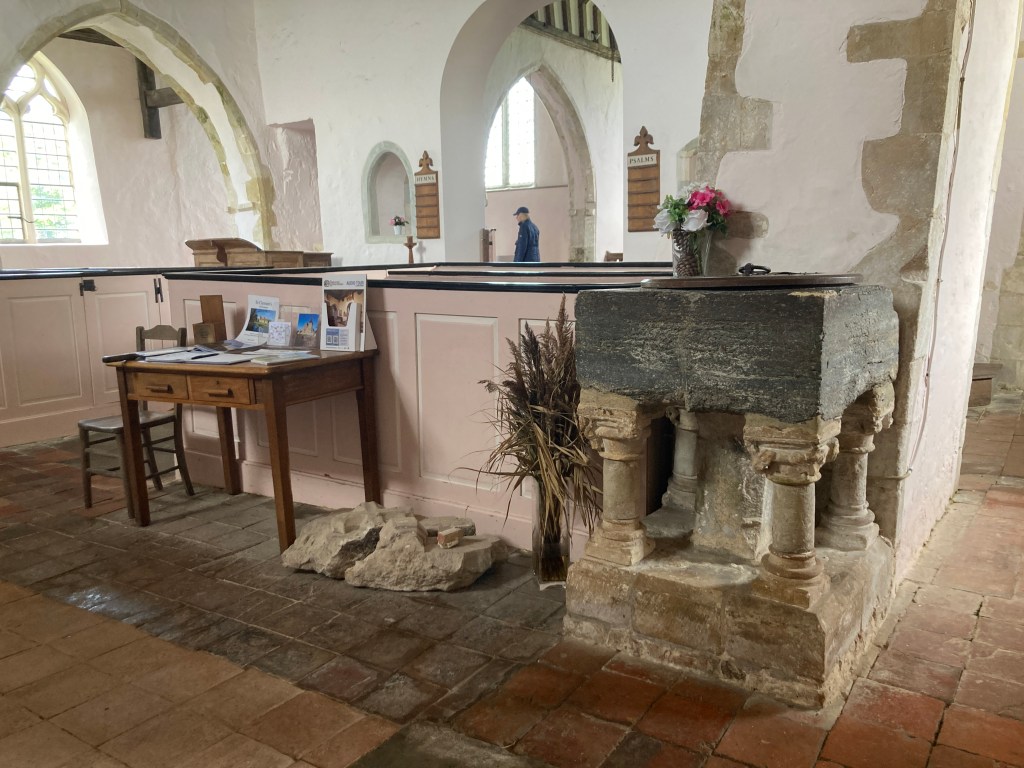
Derek Jarman is buried in the churchyard of Saint Clement’s but the interior of this ancient church is worth seeing. There is a plaque stating that Walt Disney paid to have the pews repaired and painted when they were using it as a location for Dr. Syn, Alias The Scarecrow. I remember going with my father to see this film when it came out. It was released as a Disney double-bill with The Sword in the Stone, an animated treatment of T.H. White’s Arthurian novel. I must have been nine or 10 years old. So, at least 60 years ago.
I hadn’t realised that The Sword in the Stone would be a cartoon, and I was a bit disappointed.
However, I did enjoy the swashbuckling tale of Dr Syn, played by Patrick “Danger Man” McGoohan (invariably cast as an egotistical loner), who was supported by a distinguished English cast (wasted on such tripe). If there was much of a plot I have forgotten it. I don’t remember being terrified.
***
The visit to Saint Clement’s piqued my curiosity
I discovered that the film was based on novels by author and actor Russell Thorndike (1885-1972), the first of which was published in 1915. The second, Dr Syn on the High Seas (dedicated to John Buchan), arrived 20 years later, after which five more followed in short order. Published by Thomas Nelson, they were apparently very popular in the years leading up the Second World War. The Disney version I saw was the third time it had been filmed. Peter Cushing had also had a crack at it.
***
Dr Syn on the High Seas is set in the mid 18th century. It recounts the rambling, preposterous tale of Dr Christopher Syn, a high-born cleric from the Kent Marshes, who abandons a comfortable living to become “Captain Clegg”, a fearsome buccaneer.

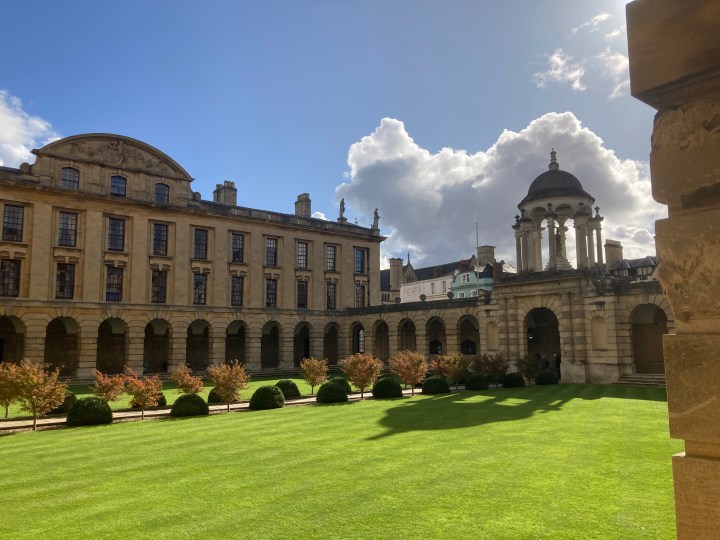
I was amused to read that, at the beginning of the story, Christopher Syn is an Oxford don – in fact, he is the youngest don at The Queen’s College, my dear alma mater. But why so? As far as I know, Russell Thorndike did not go to Oxford, or to any other university. Was the choice of Queen’s for his anti-hero a random one, or was there some connection? I am trying to find out, with the help of the college’s librarian. But I am not hopeful.
In any case it’s an interesting choice because the college was entirely rebuilt in the early 1700s, and would have been brand sparkling new when Dr Syn was appointed!
As with his contemporary, W.E. Johns (creator of “Biggles”), there’s nothing to suggest that Thorndike was much of a scholar himself. His style is crude, pompous and cliché-ridden. Often it is laugh-out-loud funny, albeit intentionally. Yet it has that all-important page-turning quality: you want to find out what happens next.
Not only is Christopher Syn – tall, dark and handsome, classicist, man of the cloth, accomplished horseman, expert swordsman, etc.- a brilliant tutor at Queen’s College, but he falls in love with and hastily marries a beautiful, wealthy señorita from Spain (or Spanish America: the text is a bit confused). This is a novel I really should have written myself! I would have been better qualified to do so, since Thorndike knew even less about Spain and the Spanish language than Oxford.
The bewitching señorita is called “Imogene”, a name I have never come across in my 50 years’ acquaintance with Spain and all matters Spanish. Why not Carmen, Leonor, Inés, Teresa, Beatriz … or even Concepción? As for her surname, “Almago”, surely Almagro is what the author intended? I suppose in 1930s England no-one was too bothered about the lack of authenticity.
I won’t relate the plot, as life is too short
Briefly, Dr Syn is betrayed by the blackguard Nicholas Tappitt (alias “Black Nick”, though not actually black) who makes off with Imogene. Syn pursues them doggedly to San Sebastian and Cadiz, and thence to Cuba and the English colonies. It’s obvious that Thorndike knew more of the geography and customs of 18th-century New England than those of Spain.
The novel ends back in Kent, with Dr Syn now the vicar at Dymchurch but with his quest unresolved. More swashbuckling is to come.
***
It’s fair to say that this novel (the only one in the series I have read) has not aged well. It’s very boozy and violent, and quite unsuitable for children. In one incident, a mulatto has his tongue cut out, and not for doing much wrong.
As for the author’s ingrained racism, compare W.E. Johns, mentioned above. The Spanish are generally lazy, though their nobility are often honourable, and the women beautiful and passionate, if somewhat unreliable. The Red Indians are savages, always up for a bit of scalping. “Yellow Pete”, the treacherous Chinese cook, gets his just desserts. “Black Satan”, a notoriously cruel pirate (yes, he is a black man), is despatched by “Captain Clegg” with the assistance of a passing shark.
I quote, with some trepidation, from the Restored Edition (2025), p.155.
“I have a score to settle with you,” replied the pirate.
“For killing that damned n——?” asked Syn. “How could you as a white man have brought yourself so low as to serve under such a man?”
The n-word is printed in the original text, here and elsewhere. And it’s far from an isolated example.
I was genuinely shocked
I’ll let that sink in for a bit… I fear it tells you more about racism in the 20th century than in the 18th. It goes well beyond “old-fashioned”. White men are innately superior; it is not so long ago that authors could state or imply this with impunity.
The edition I have, with an introduction by Robert Statzer, is printed by Amazon, but it’s not clear who the publishers of “The Restored Editions” are. The introduction doesn’t include what we have come to call a “trigger warning”. Did the publishers consider the issues raised in re-issuing a book that uses this type of language? How would Amazon respond if I reported it? Or are they post-woke now?
***
In 2006 the BBC made a 10-part audio series, read by Rufus Sewell. I was looking forward to listening to it, in part to discover what the producers had left out. But none of the episodes “is currently available”. Very disappointing.
But then I found that “Mystical Magpie” had kindly posted all 10 episodes on You Tube. It has undergone a considerable amount of editing – as usual – for broadcasting. And it’s none the worse for it. You will find the passage I quoted above, 1h 12m in.
“I have a score to settle with you,” said the pirate.
“For killing your captain?“.
The offending word had been expunged, here as elsewhere
Will I be reading any more Dr Syn novels? Probably not: one is enough.
 The Wight Stuff