We would leave Romania with happy memories, excited to be visiting Bulgaria for the first time.
Tuesday 8 September
We rose at 8am to check out of the Rembrandt Hotel, stopping for coffee on the way to the metro. Our remaining lei were blown at Bucharest Autogara on fruit juice and snacks for the journey. FlixBus 983, destination Thessaloniki, left promptly at 10:10.
I’ve never been comfortable reading on a bus, so I wrote up my notes about our week in Romania. I am aware that, as visitors, we only catch a glimpse of other countries, and that our impressions, positive or otherwise, can be tempered or contradicted by local people – assuming you take the opportunity to ask a question.
I like to talk to taxi drivers
Whether they enjoy my conversation I can’t say, but they tend to have views on most things. In Sibiu I got chatting (initially in Romanian but very soon in English) to a taxi driver who, when a lorry driver, had lived somewhere near the Channel Tunnel entrance for many years. Eventually his wife and children wanted to go back home, so they had returned to Sibiu. And how did he find it? Good, 10 years ago, but not so good now. Why? Corruption at the highest level. When you only spend a few days in a country you may be blissfully unaware of its socio-political problems. I now read that Romania has the most NEETs of any European country, with nearly 20 percent of 15 to 29 year olds not in work, training or education. Could this be related to its large Roma population, even if efforts are finally being made to help them find jobs?
***
We travelled due south across the Wallachian plain.
Over the Danube on the Friendship Bridge
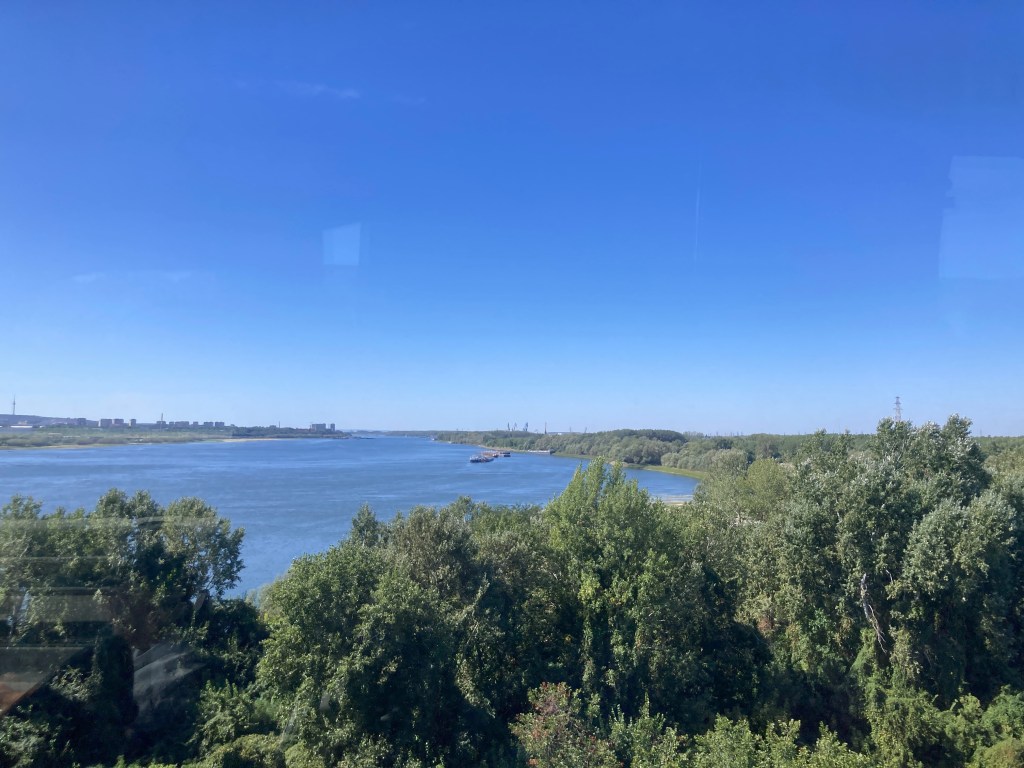
Shortly after Giurgiu, the final town on the Romanian side, we crossed the wide Danube via the Friendship Bridge to Ruse.
The dual carriageway, the main route to Sophia, now turned into a poorly maintained single carriageway road; it improved after a while but progress was slow. From the front of the bus we had a panoramic view of rolling hills, forests and huge fields – presumably the result of Communist collectivisation in the last century. Houses were few and far between, and my impression was that people were a bit poorer than north of the border.
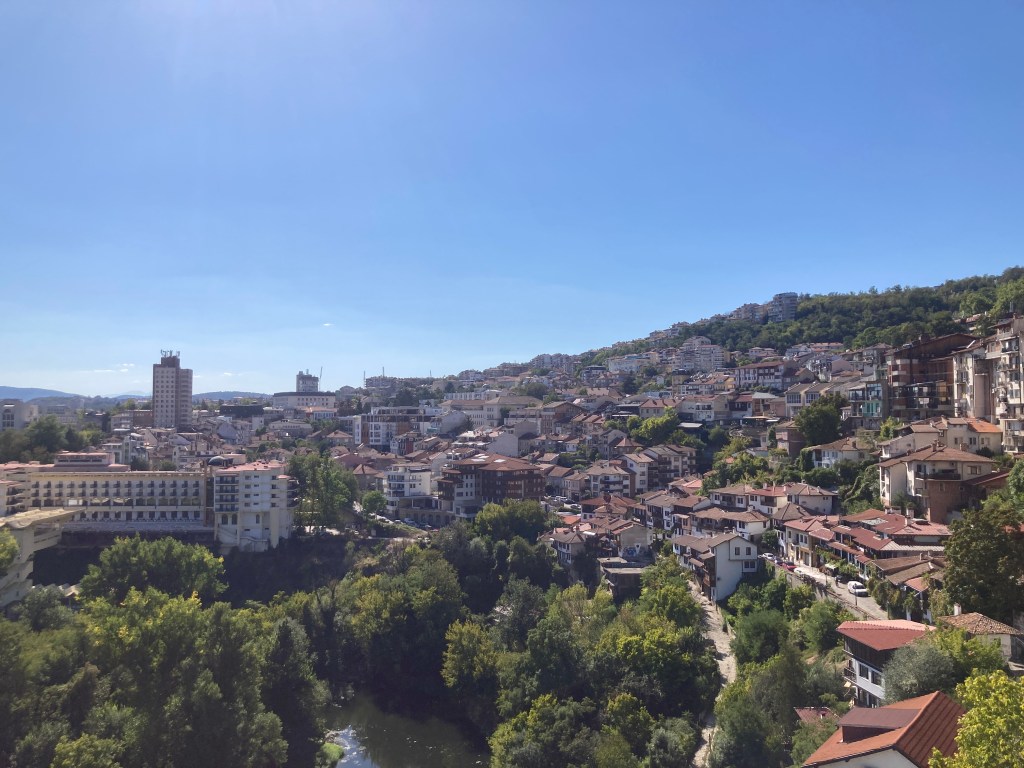
It was mid afternoon when we arrived at the former Bulgarian capital of Veliko Tarnovo. The old town sits on three hills, with the bus and train stations at the bottom. It was much too hot to walk up with our luggage, so we took a rip-off (10 euro) superannuated taxi to the budget-friendly Hostel Mostel. The hostel is in a renovated old house, with private rooms (of which we had one), shared dorms and a lot of outdoor space.
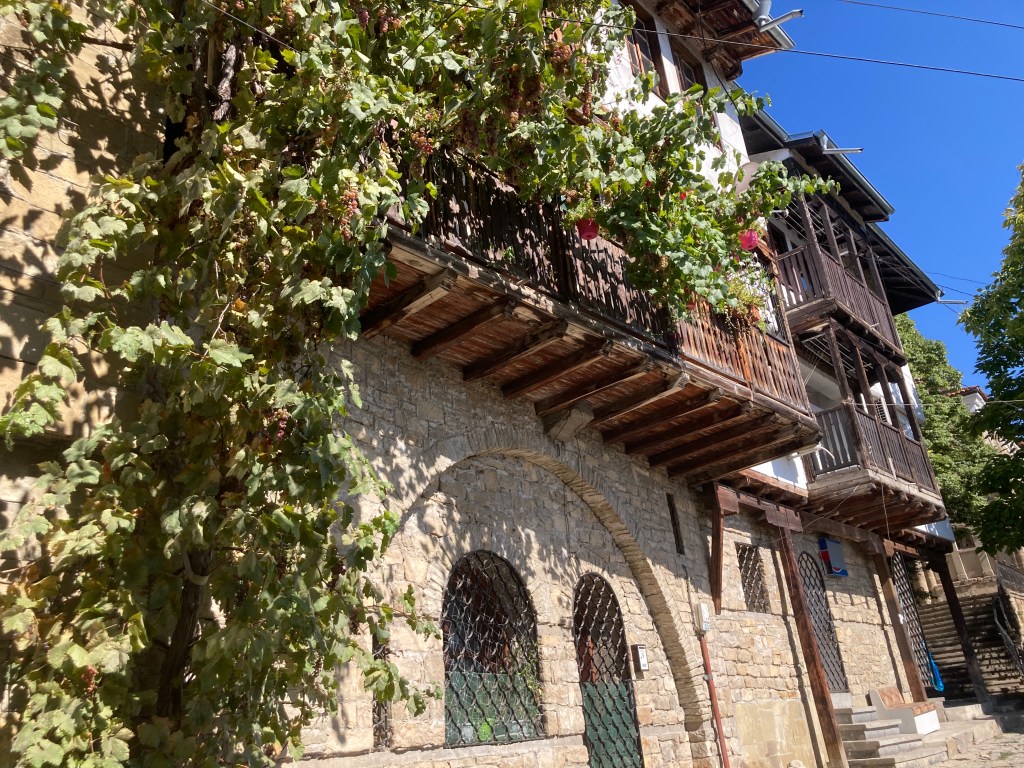
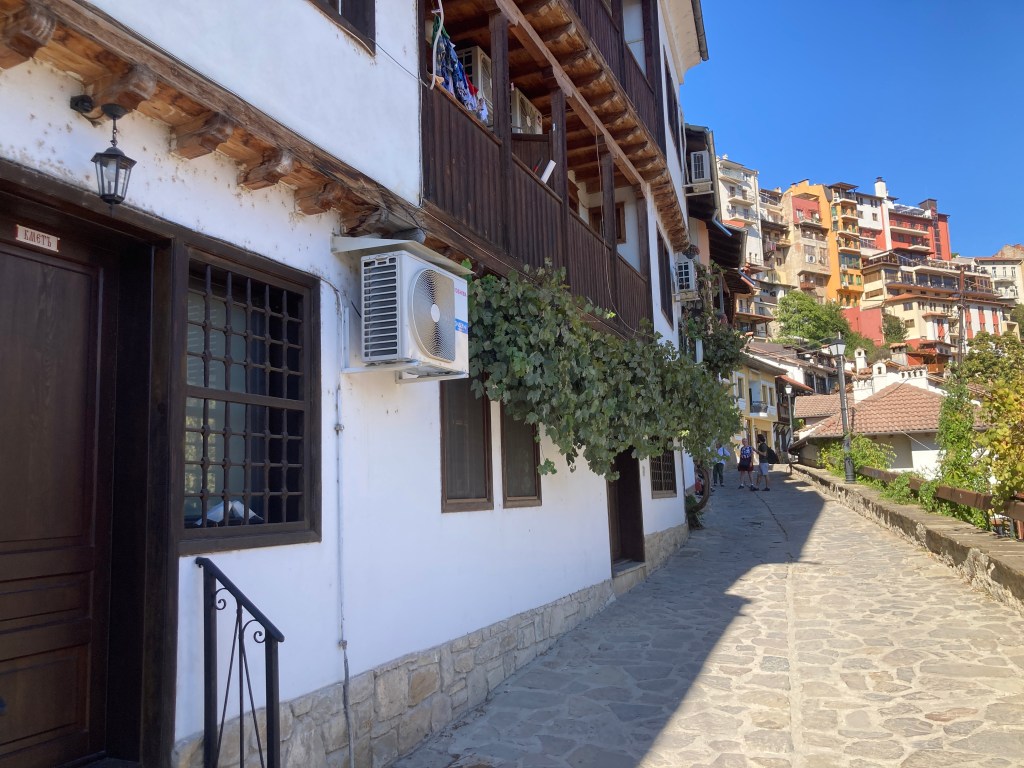
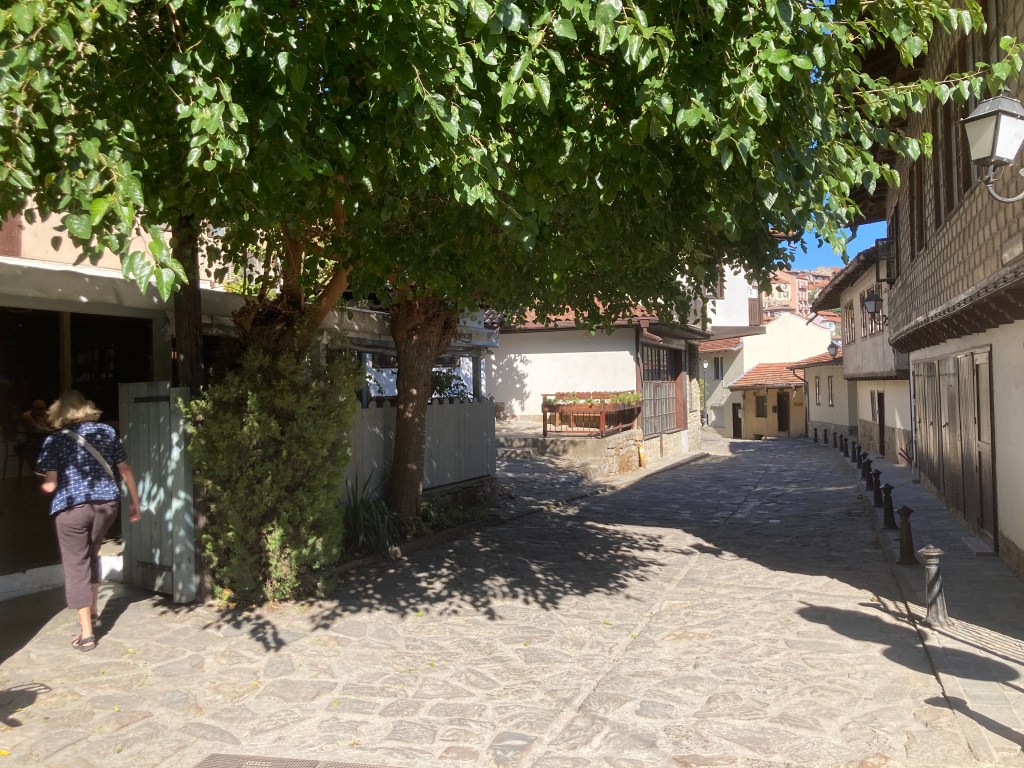
We dumped our stuff and set off to explore the old town, often described as the spiritual homeland of Bulgaria – and, incidentally, the biggest producer of plastic bags in the country. We walked up a relatively quiet residential road then into ul. General Gurko, with its traditional balconied houses, then down a narrow lane to the peninsula known as “The Nose”. At the bottom of the hill by the river is the huge and hideous Asen monument and the imposing Boris Denev State Art Gallery. We were almost the only visitors.
It was hot and humid… and time for a glass of wine
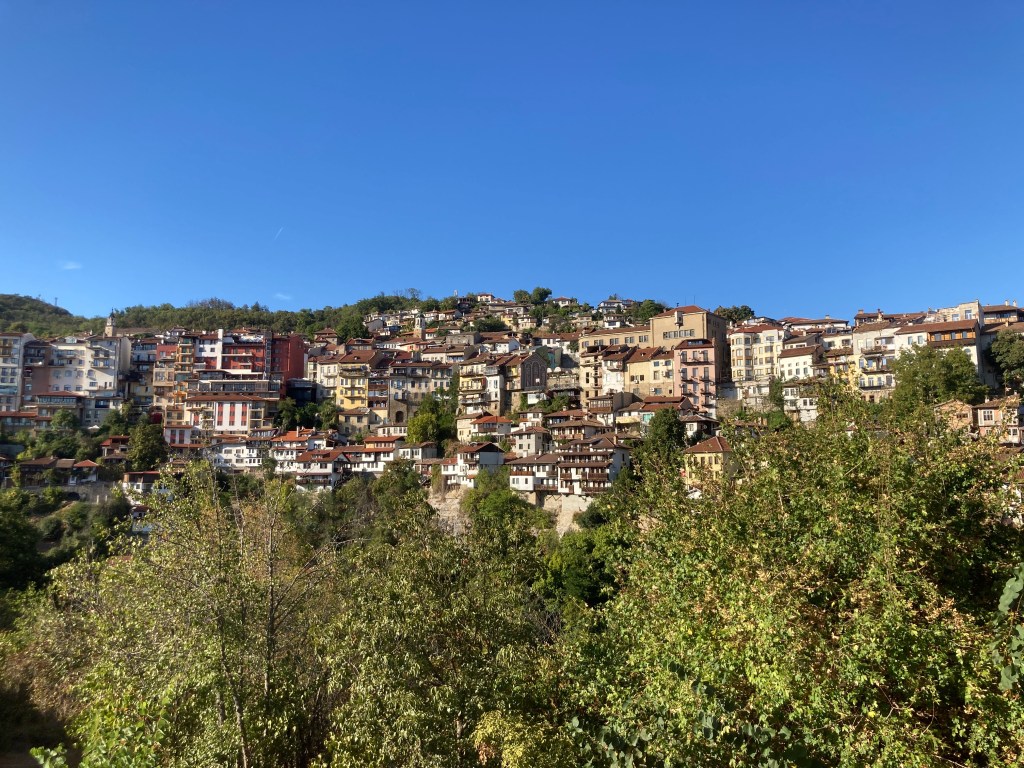
View of the old town from Bar Galariya
From the Galariya bar on the terrace of the Denev there are great views of the town high above. Dragging ourselves away, we laboured back up the hill for dinner at Han Hadji Nikoli, a historic restaurant in the old town.
Back at the hostel we sat outside chatting to sociable young travellers from Brazil, Bulgaria and Australia. I spoke a bit of intoxicated Portuguese before lapsing back into English. It occurred to me that I spend very little time talking to younger people and perhaps ought to do something about it. They do have a different perspective on things.
Wednesday 9 September
Surprise, surprise: it was sunny again.
Tsarevets
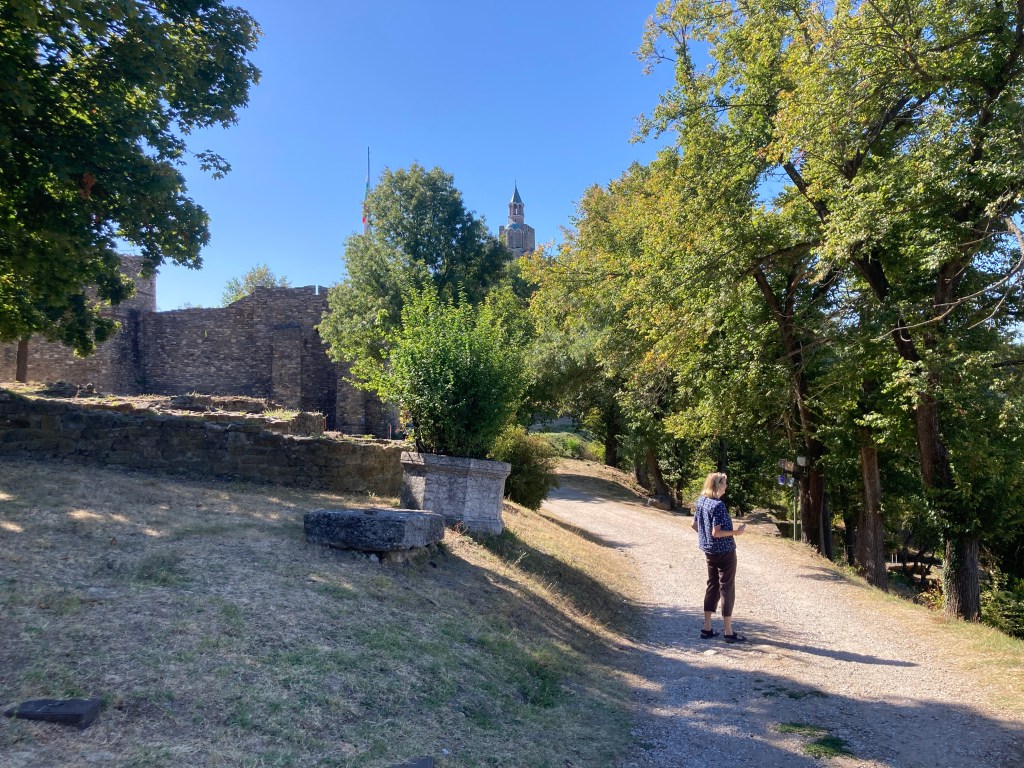
We walked the short distance up to the Tsarevets fortress before it got too hot. It is the major attraction of the town, although the churches and palaces for which it was once renowned have gone, leaving little other than walls and fortifications. In truth, there is not much left to see, though the site itself is imposing with superb views. Downhill, next to the stone bridge, is the Asenova quarter, with the churches of the Forty Martyrs and Saint George, which both have fine frescos.
***
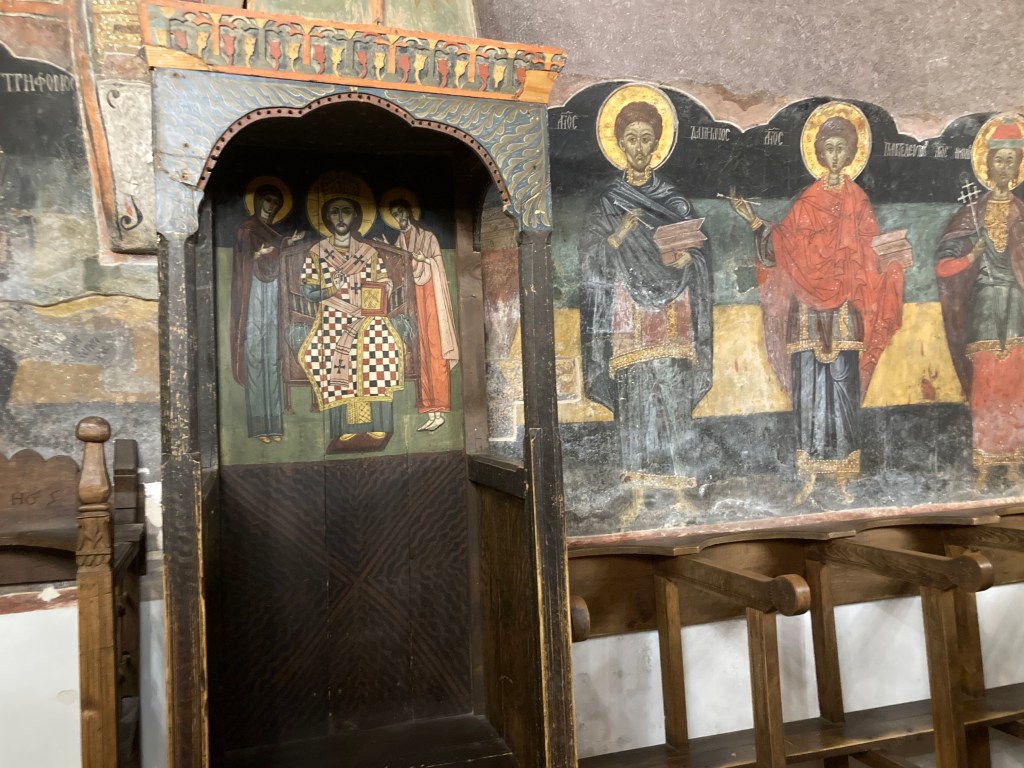
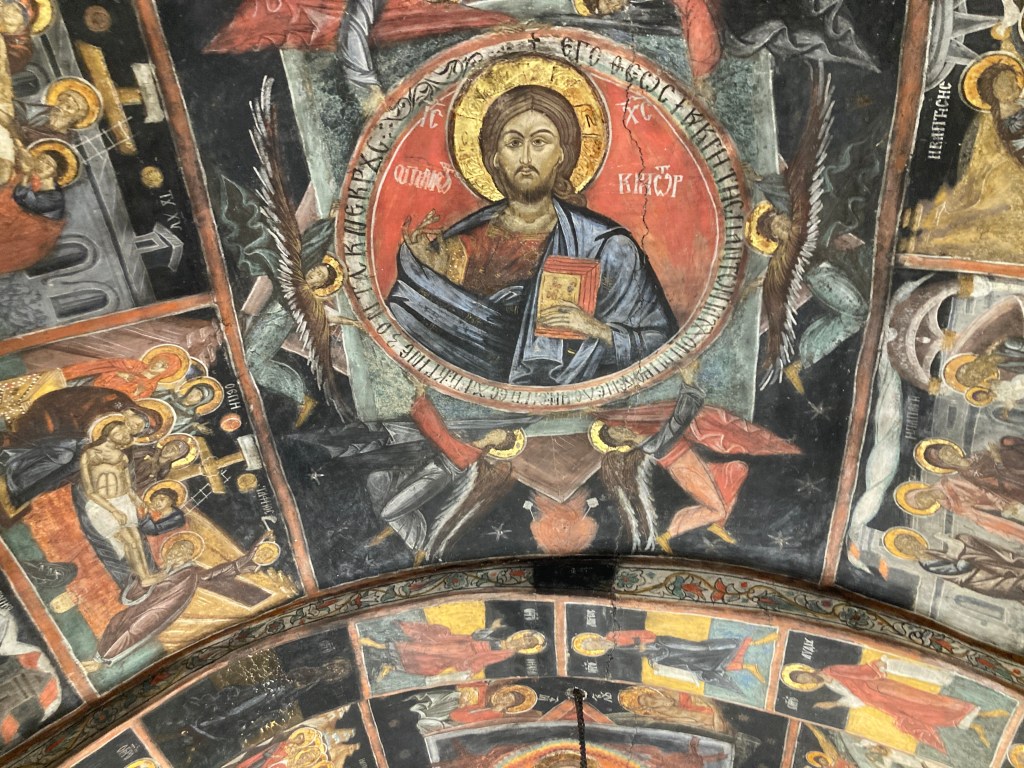
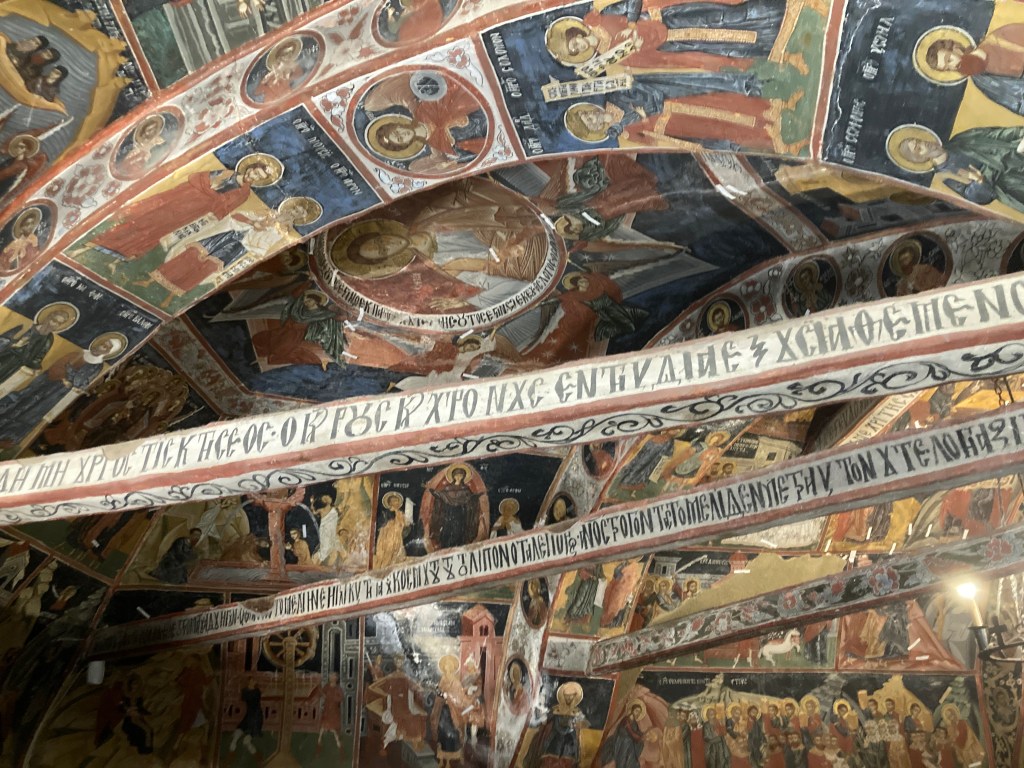
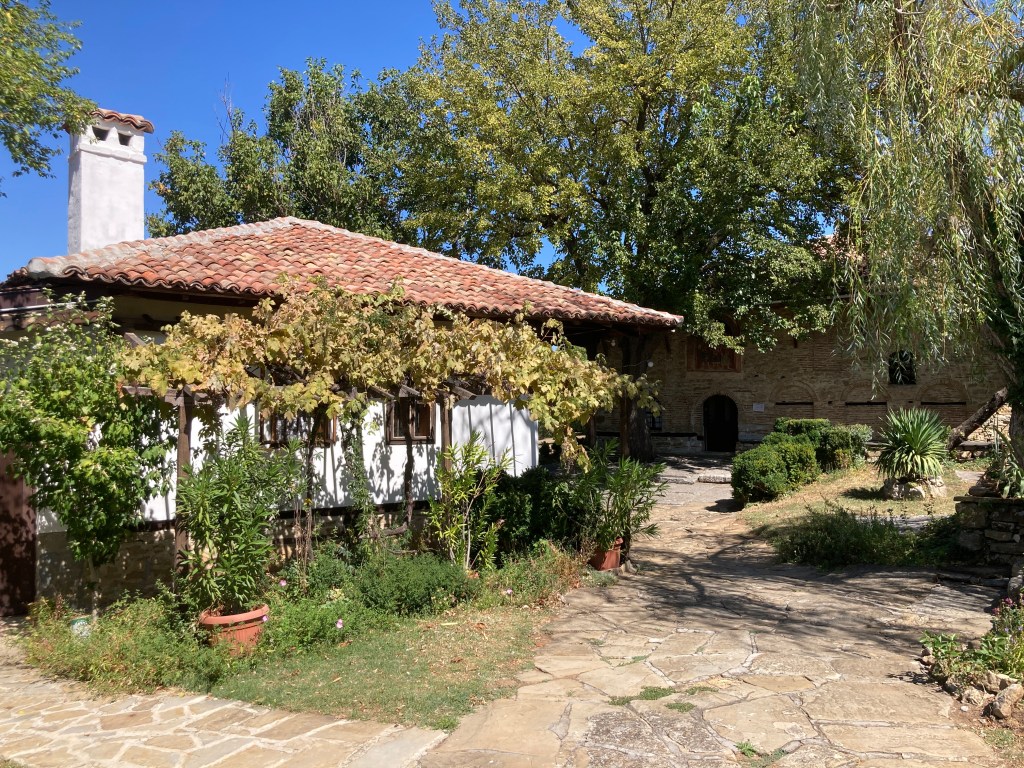
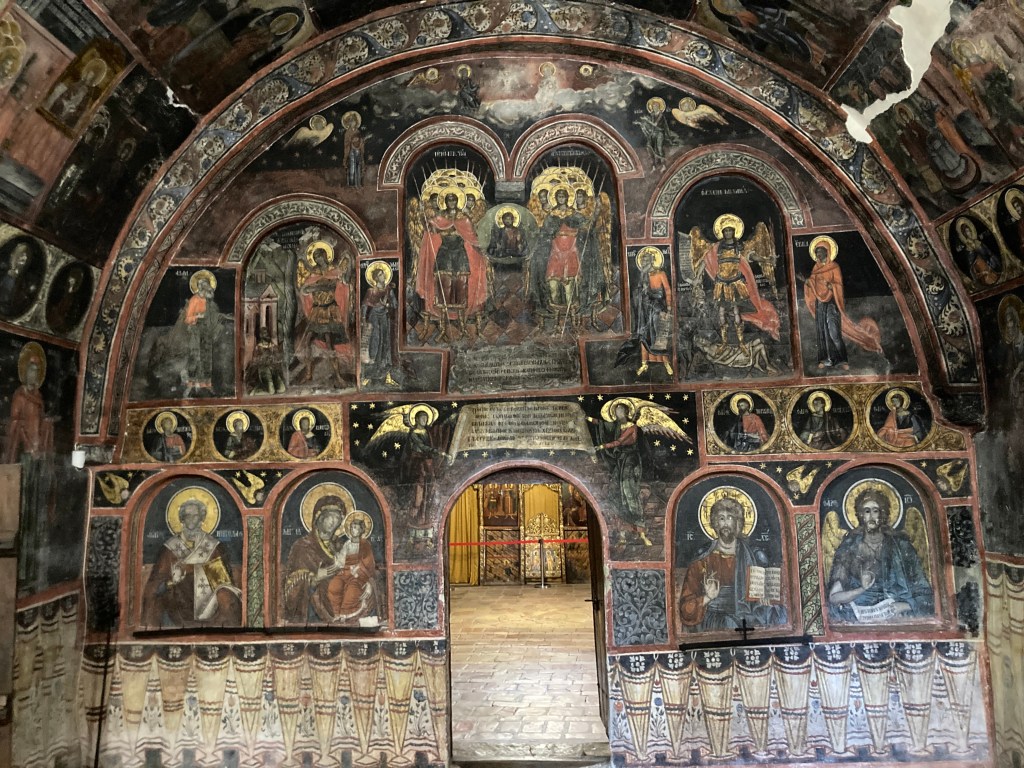
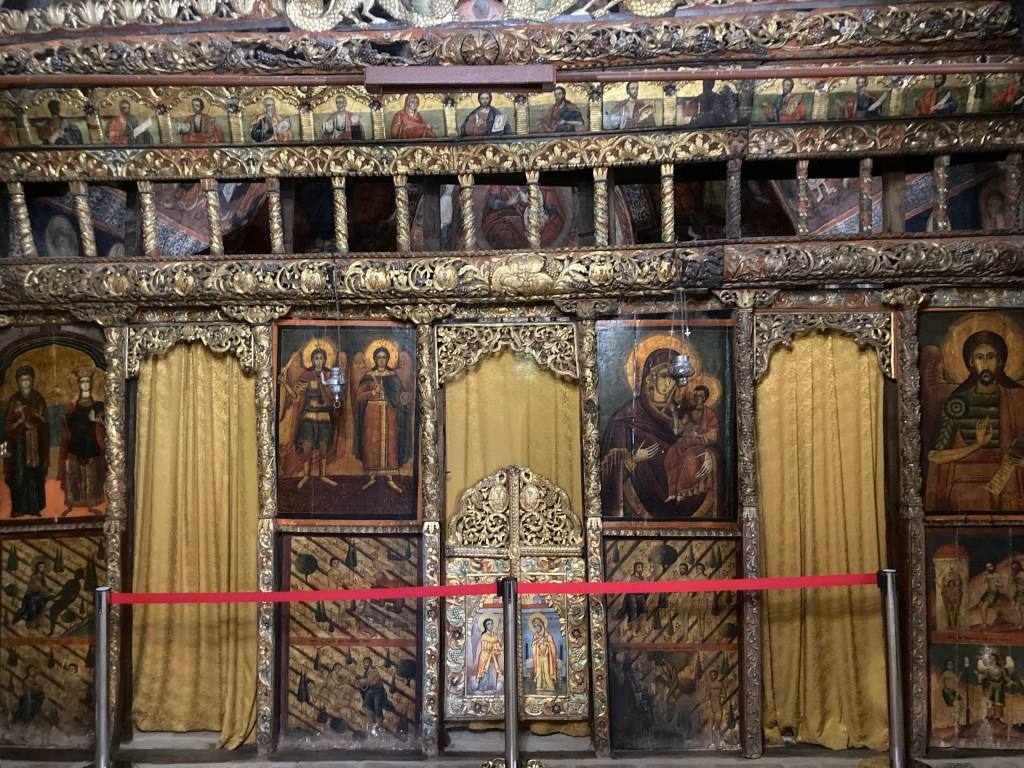
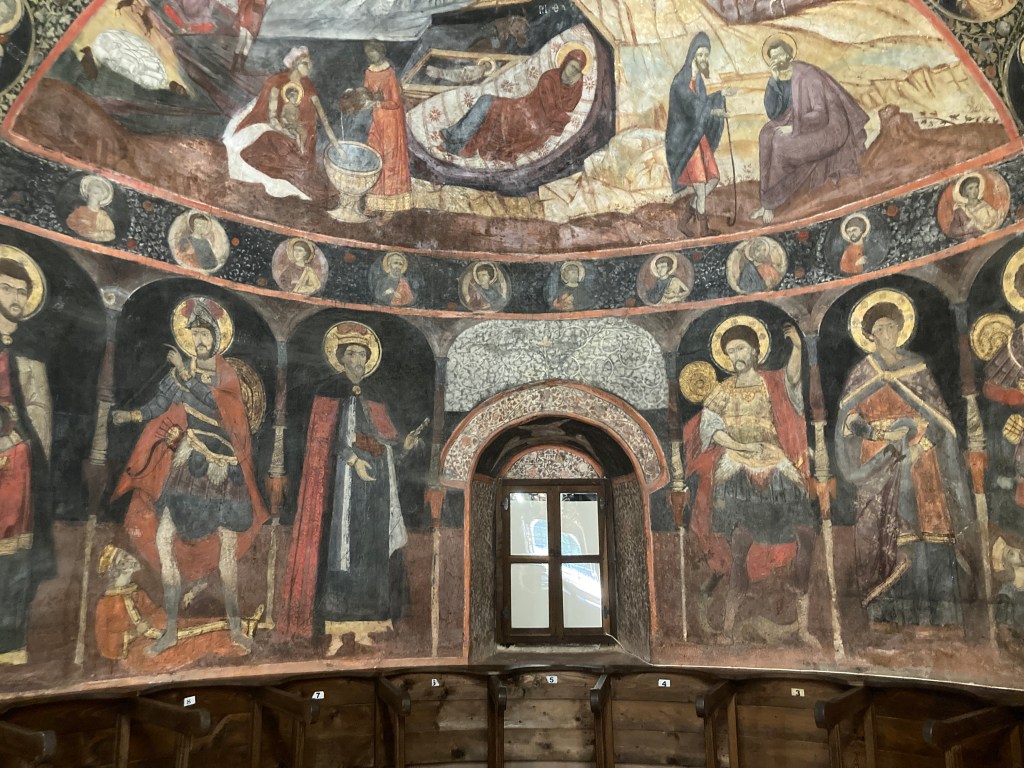
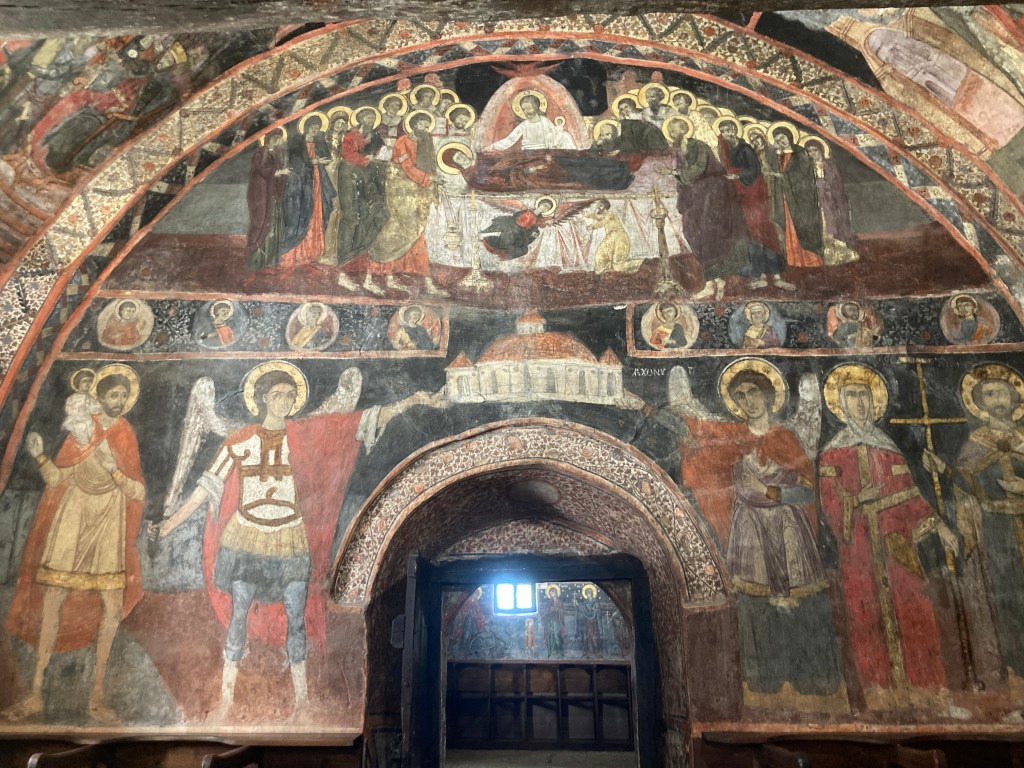
But the highlight of the day was seeing the village of Arbanasi, only 4 km away and less than five euros by taxi. Tour coaches park on the main street, where there are a few restaurants serving excellent local food. But if you walk away from the road it soon becomes peaceful. Once the groups have moved on you have the churches to yourself. We loved the magnificent frescoes in the Church of the Nativity of Christ (15th-17th century) and the Church of Archangels Michael and Gabriel (16th-18th century).
There is an infrequent minibus to and from Tarnovo. Tickets are 1.12 euro each; not much of a saving on a taxi and a memorably uncomfortable experience!
Then into town for dinner
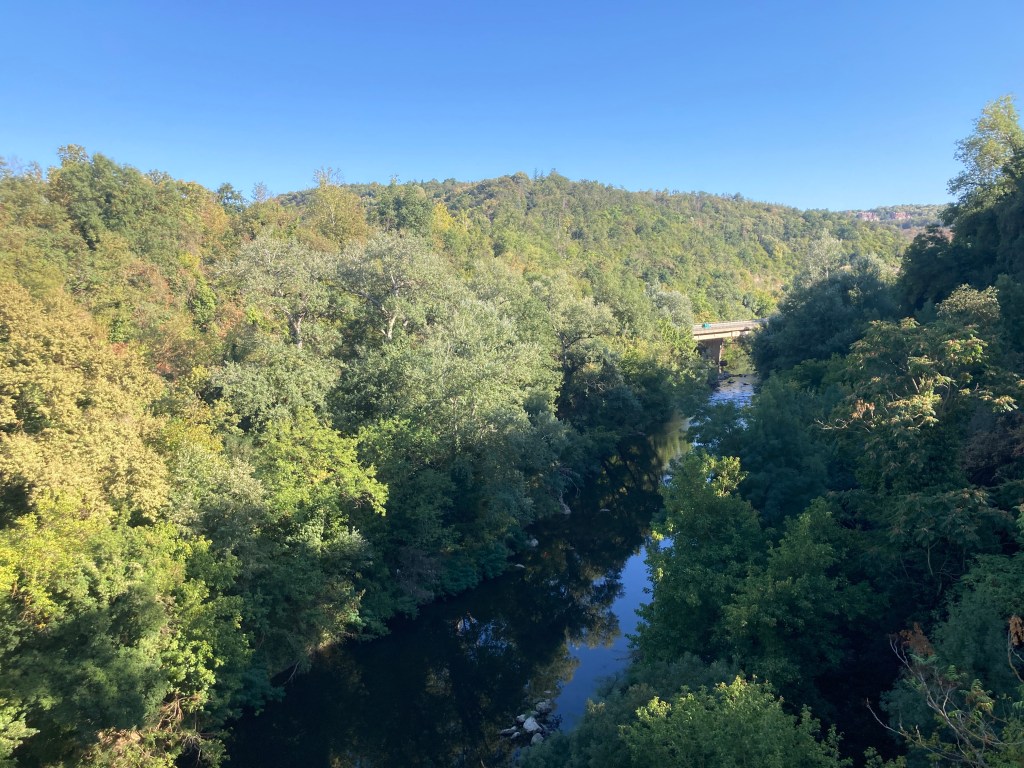
We had reserved a table at the popular Restaurant Shtastliveca (recommended by my ex-colleague Rossitza Atanassova). It has a famous panoramic view of the gorge and the town, and the food and service are really good. We shared a starter of tomatoes, peppers and creamy yoghurt, after which Anne had moussaka (different from the Greek version) whilst I went for braised veal cheek and puréed potatoes. The red wine was superb.
***
Veliko Tarnovo is well worth visiting, though more pedestrianisation would be welcome. I must also mention the vicious mosquitoes, which are in a class of their own.
I was still scratching a week later
Thursday 10 September
There is only one sensible way to get from Veliko Tarnovo to Plovdiv: namely to catch the 07:39 direct train. As there is no viable walking route down to the station it entails a nerve-racking wait for a taxi. It was still dark and a little chilly when ours arrived at 6:30.
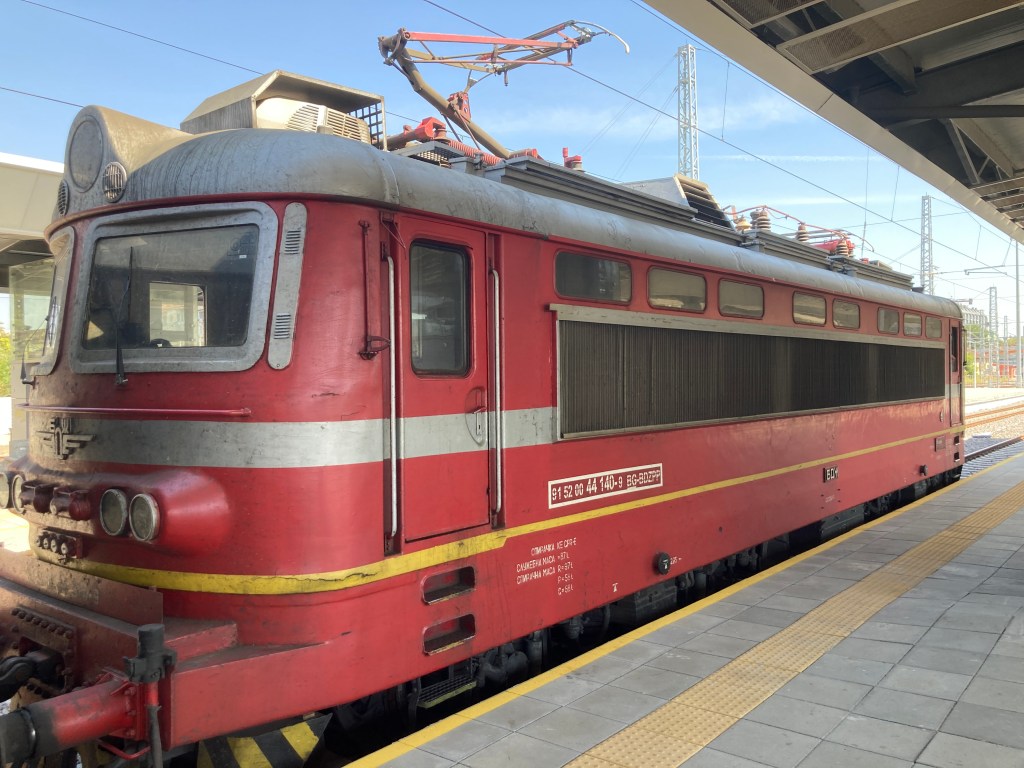
The train climbed up and over the mountains for an hour, with fleeting views of forests below before descending to a plain of arable farmland. We arrived at Plovdiv on time, just before noon.
Arriving at Plovdiv
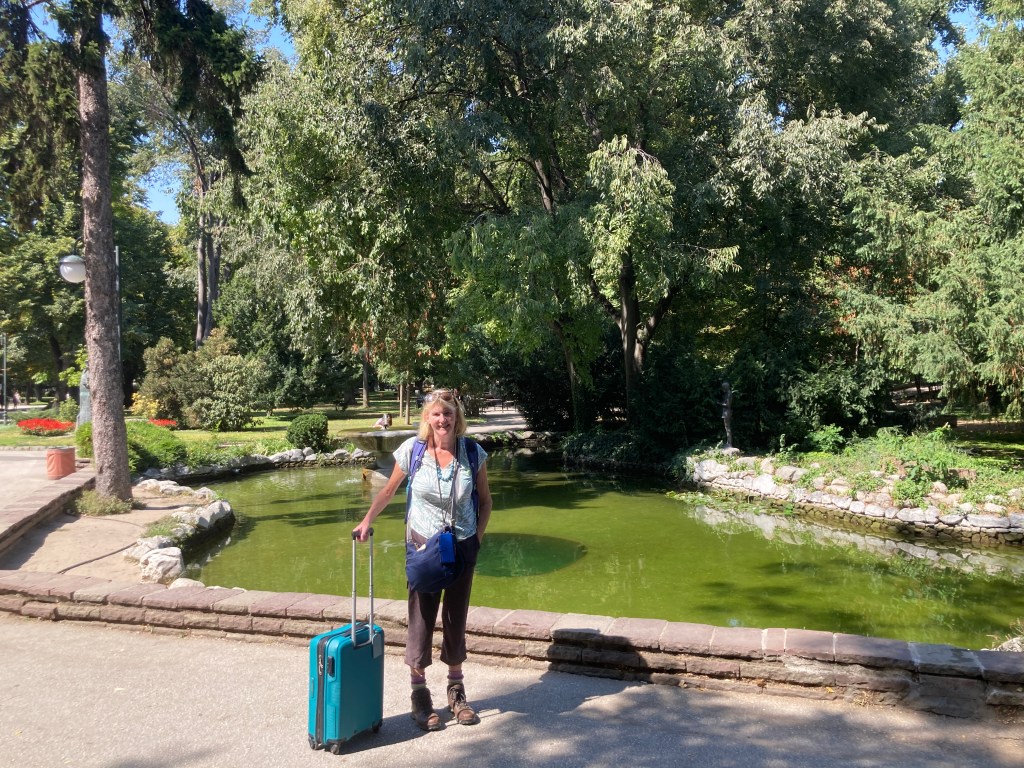
It’s a 20-minute walk from the station via the park to the centre of town.
Why visit Plovdiv?
I’d never heard of Plovdiv before we started planning this holiday, but it is the second largest city in Bulgaria and one of the oldest continuously inhabited places in Europe. It isn’t obvious when you arrive, but you soon see evidence of ancient Philippopolis. There are numerous Roman ruins (including in the basement of the H&M store).
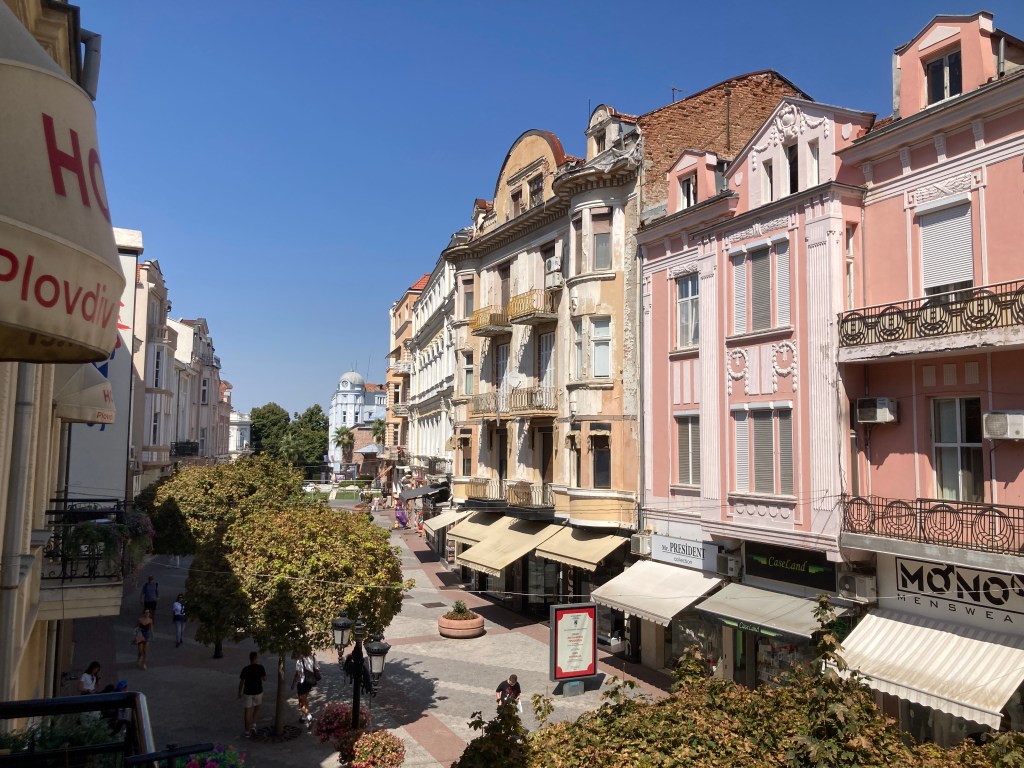
We stayed for two nights at City Center Hotel (highly recommended, 3 stars) on ul. Knyaz Alexander. It is central, lean and spacious, and has en-suite rooms with private balcony overlooking the pedestrianised main street. Great value. The well-preserved remains of the Roman Stadium are just a few minutes away. Yet again, the city has clearly benefitted from its year as European Capital of Culture.
Plovdiv is another city built on hills. We climbed up through the old town and dropped into Rahat Tepe restaurant for a beer – then decided to stay for an early dinner. Not for the first time we over-ordered: a huge Greek salad was followed by a huge hot plate of pork, chicken and veg. Who ordered chips and bread? It was enough for four, and even I had to give up the struggle eventually.
Friday 11 September
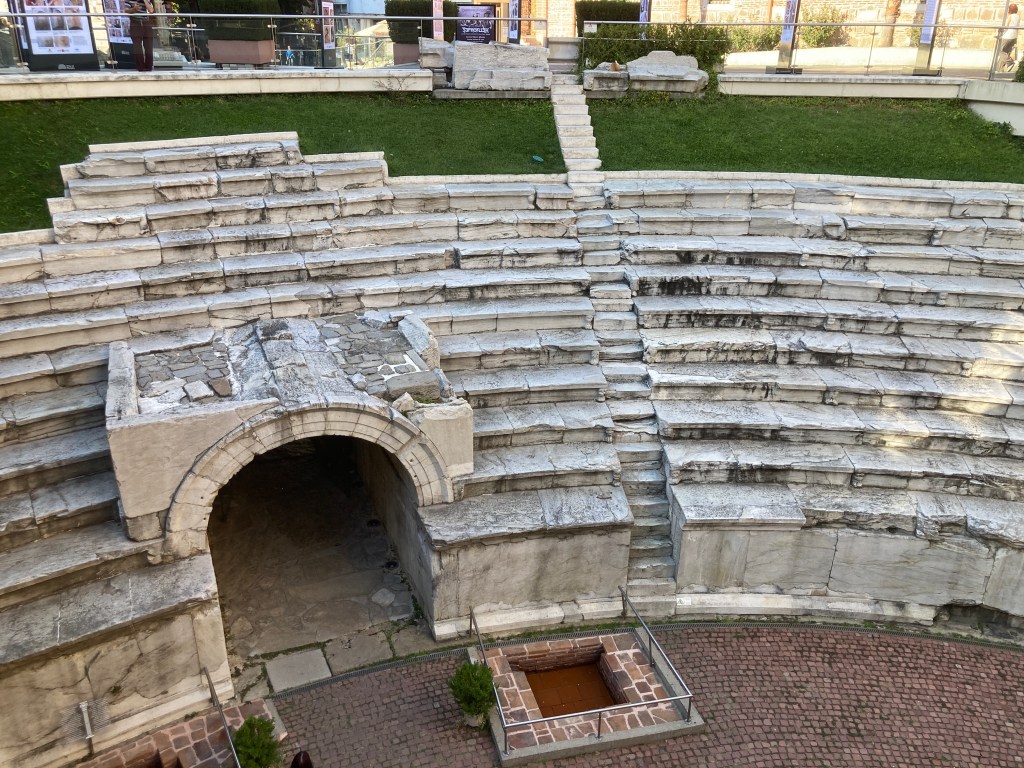
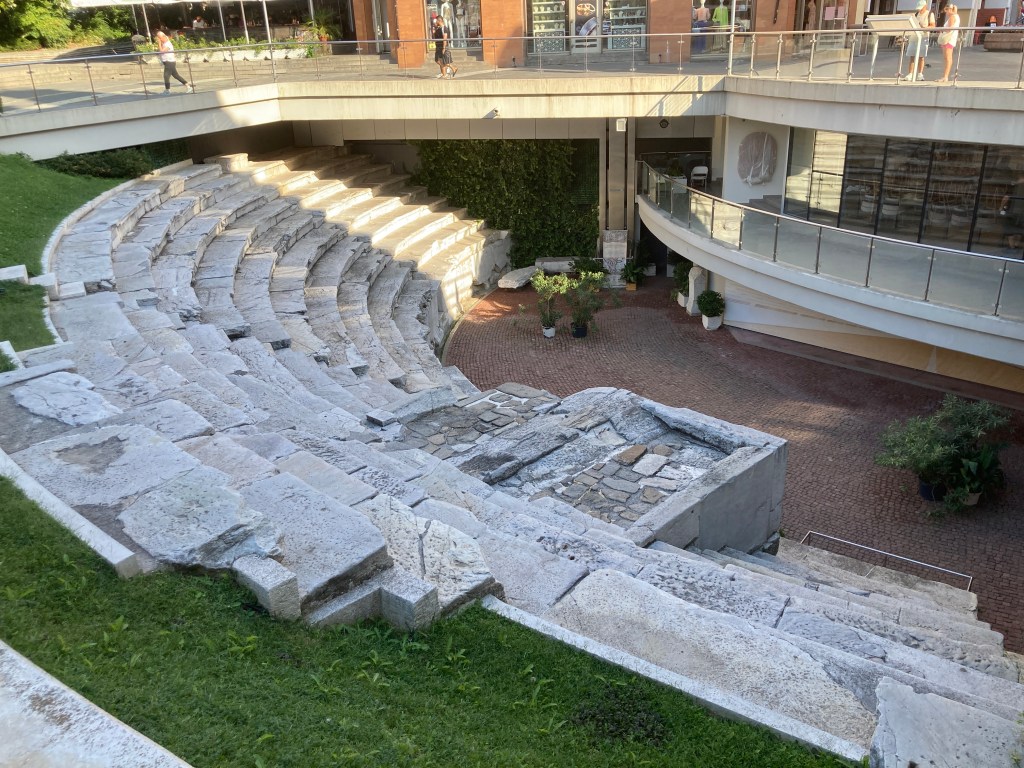
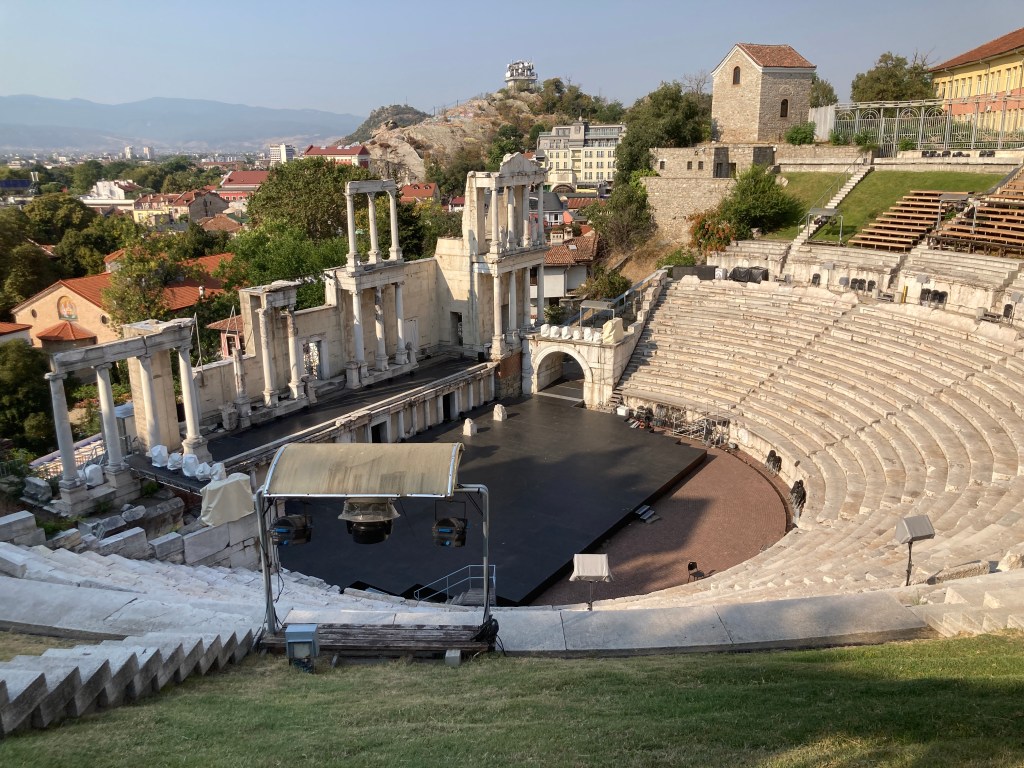
Wisely, we decided to retrace our steps from the previous afternoon and climb the hill to the Roman Theatre and see it before most tourists arrived. It is magnificently well preserved, and it is very hard to believe that it had been buried under soil and rubble, and “rediscovered” only in the 1970s.
Roman Theatre of Philippopolis
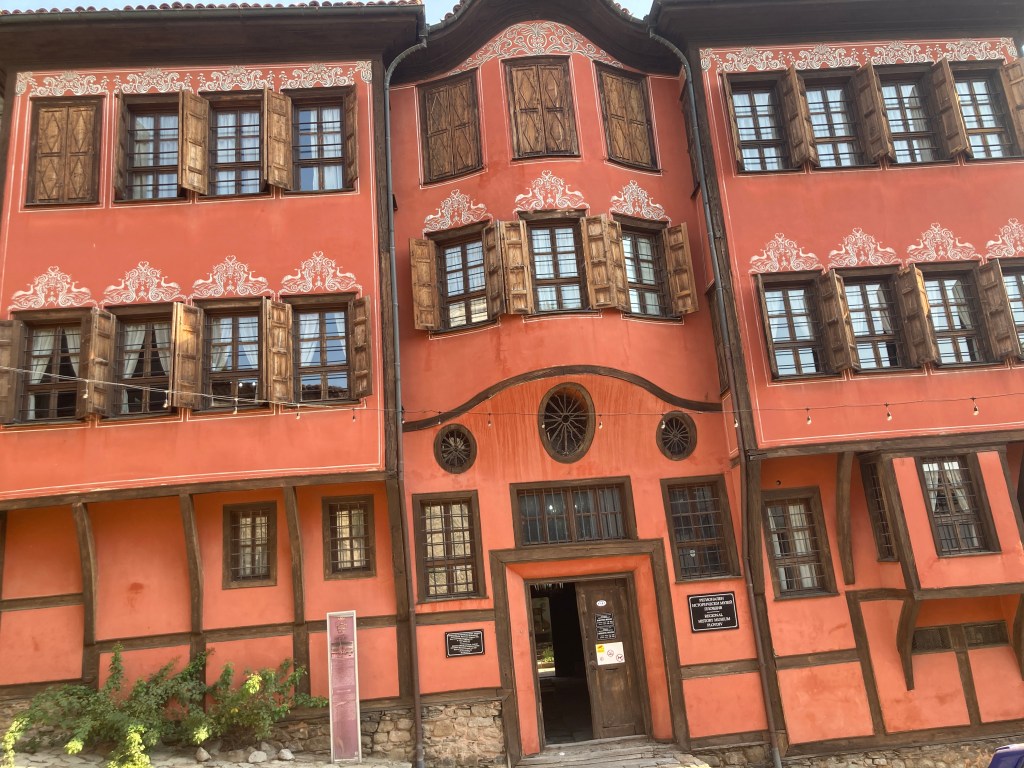
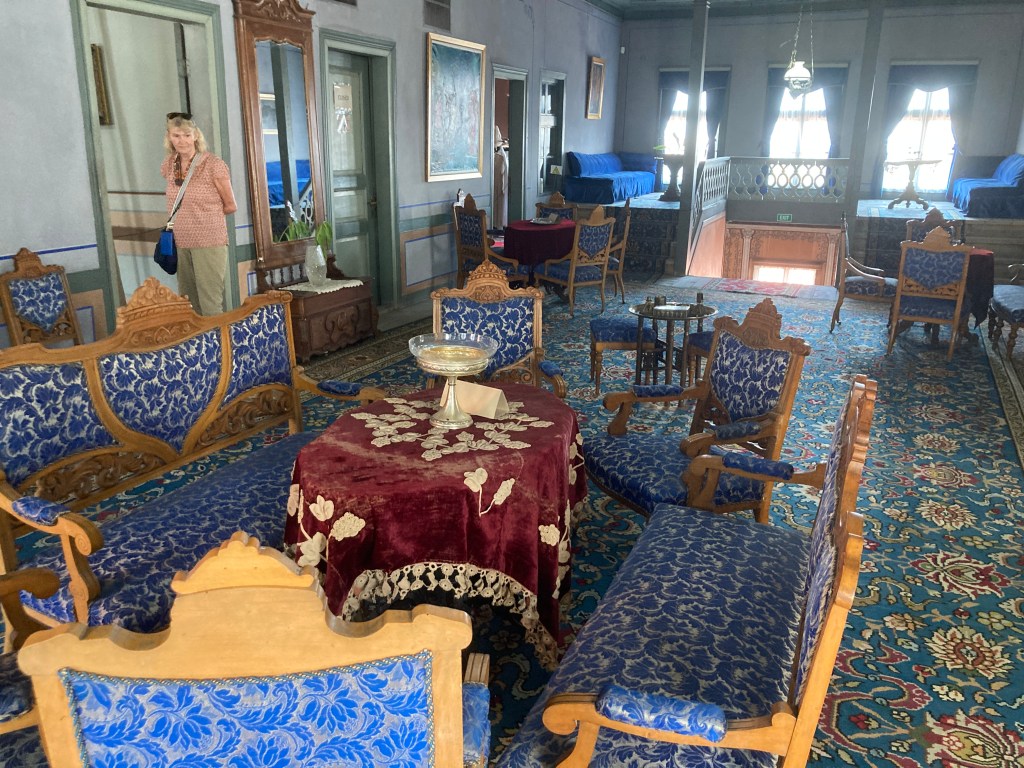
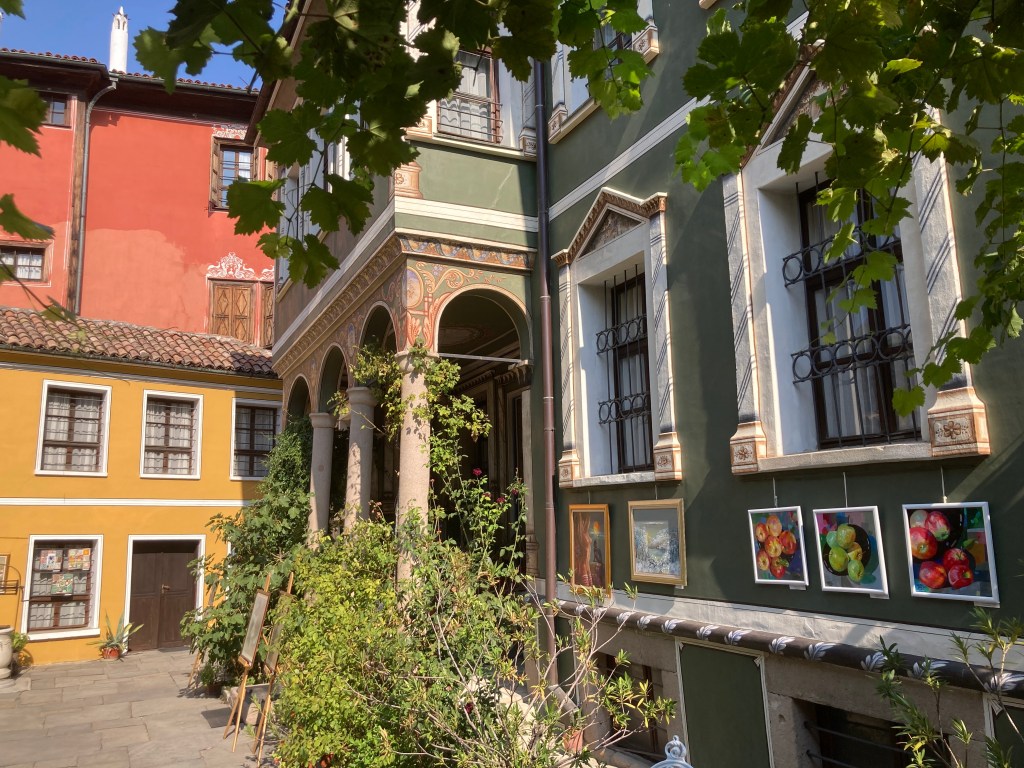
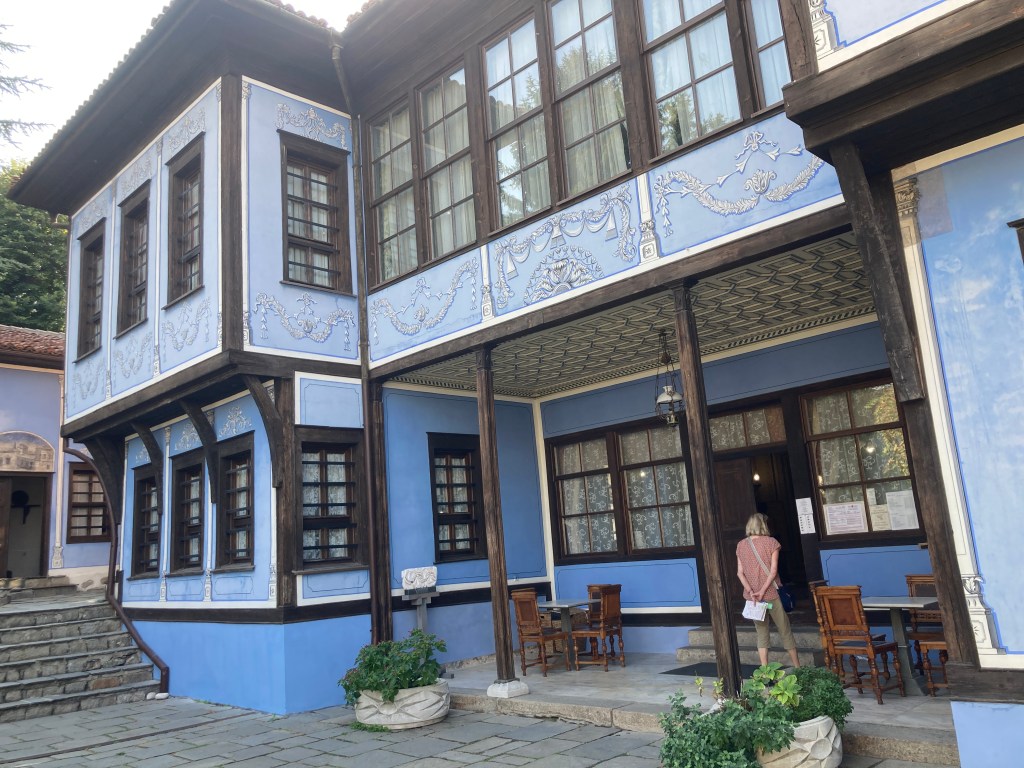
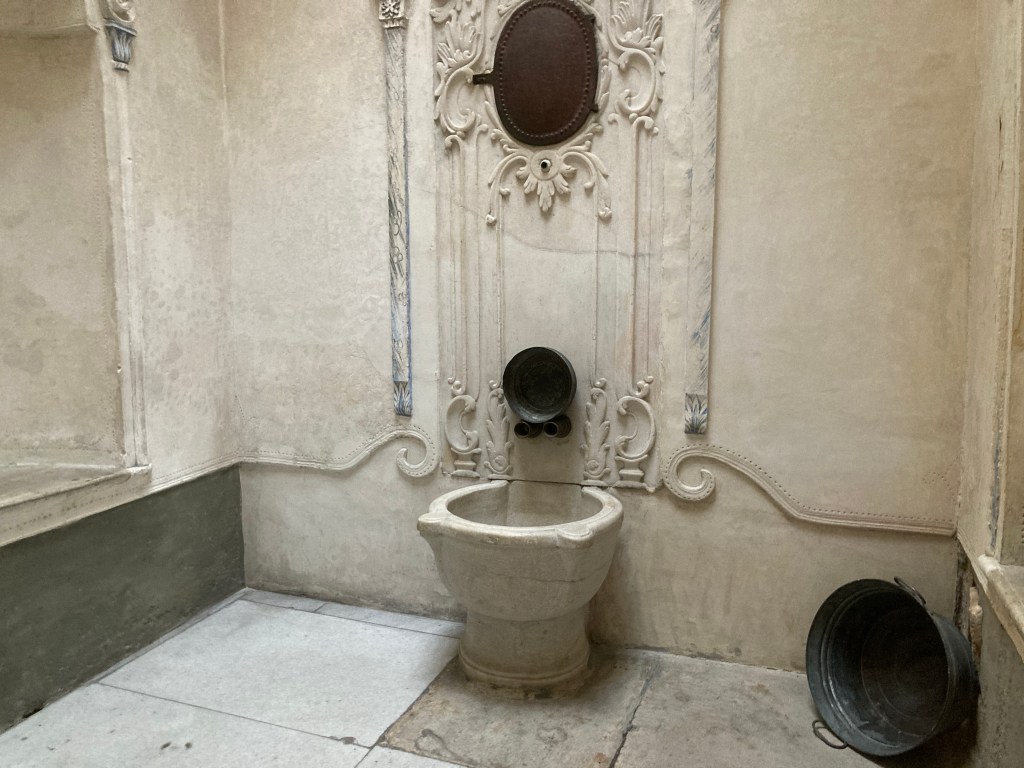
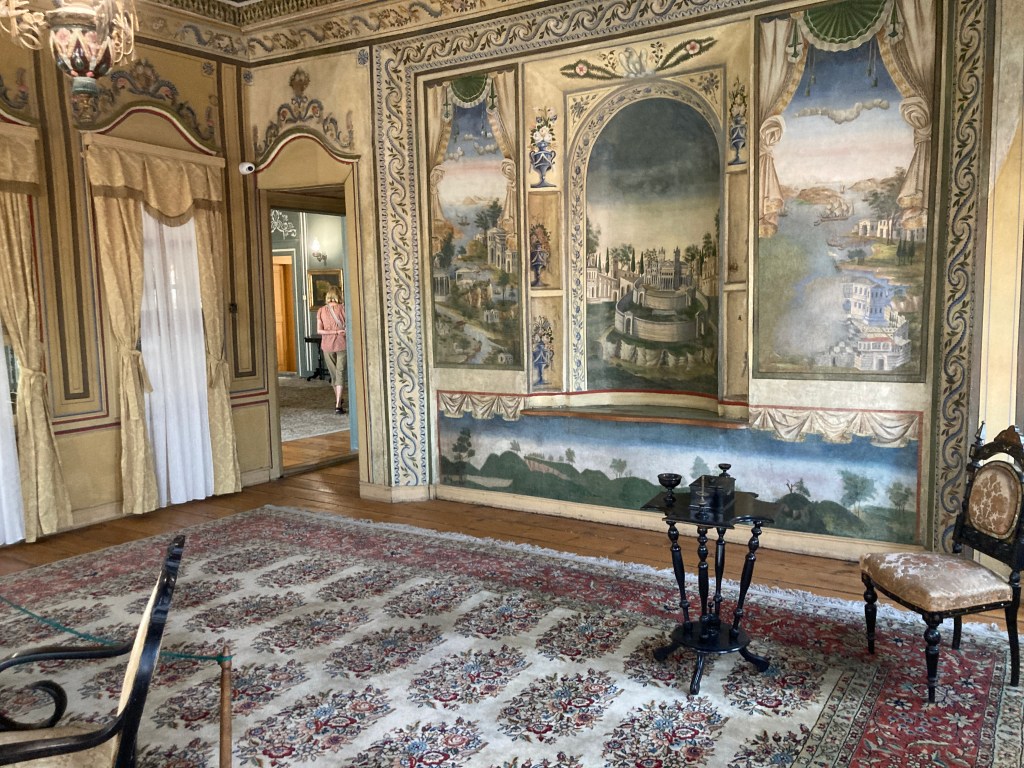
The old town has a number of museums (you can get a joint ticket), including several large, well-furnished 19th-century merchants’ houses. Wherever you go, there’s always an Armenian one!
The Kapana district (literally meaning “the trap”) of craft shops, galleries and restaurants is back down the hill. We dithered over where to go for lunch but were happy that we chose Maka Ramen: light and fresh.
***
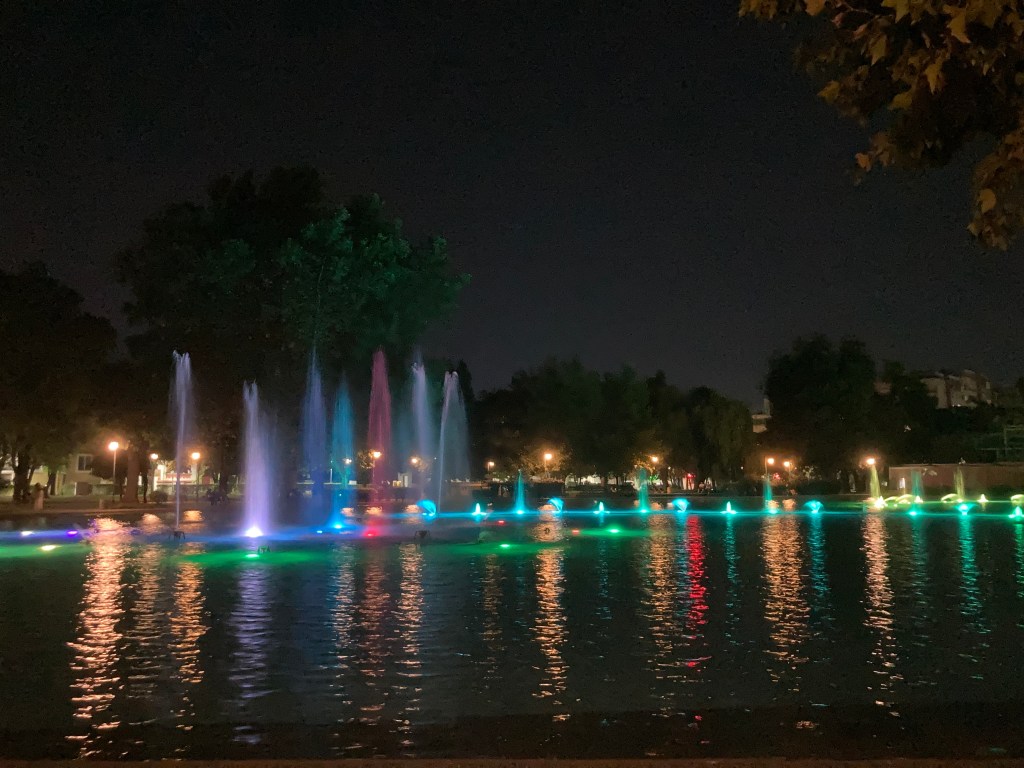
Hot though the afternoon was, we pressed on, visiting the Roman Forum before going back for a rest. Having been assured by both our hotel and the tourist office that the Singing Fountains light and sound show would take place at 9:30pm we went along to the Tsar Simeon Garden in eager anticipation.
Did it happen? No
No music, no fancy light show – but the fountains are always illuminated so it was pleasant enough sitting there and chatting to the other tourists who’d been misinformed.
The fountains in Tsar Simeon Garden
We strolled back towards the hotel, not desperately hungry but wanting something. For the first time in many years we walked into McDonald’s. I must report the fact that the burger wasn’t bad, but I have never seen such miserable and stressed-out staff.
A bottle of white Sarva wine on our balcony helped blunt the memory.
***
The following morning we would be off to Istanbul by bus. Neither of us fancied the so-called sleeper train on which you can’t sleep… until just before you are woken up at the border.